
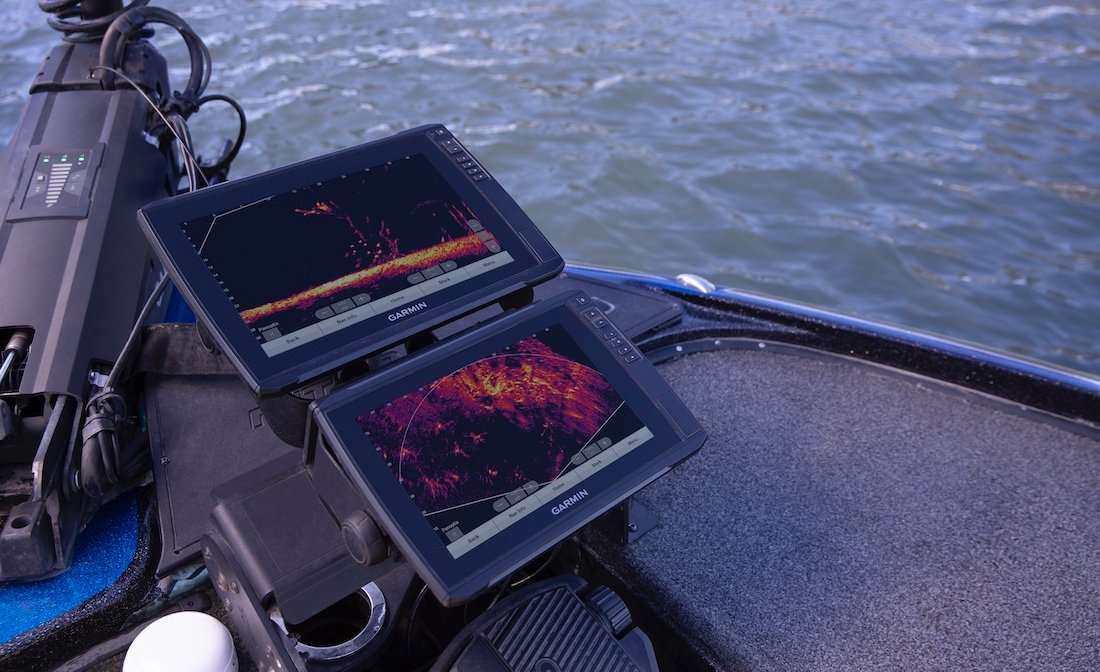
Many anglers assume that fish finders only show static images of the bottom. But Garmin’s Livescope, introduced in 2018, changed that assumption entirely. This real-time sonar system displays fish and structure moving live underwater, allowing anglers to see a fish approach a lure or flee from the boat. Unlike traditional down imaging or side imaging, Livescope uses a forward-facing transducer that scans ahead of the boat, creating a dynamic view of the underwater world.
How Livescope Differs from Traditional Sonar and Competing Systems
Traditional fish finders rely on down imaging or side imaging, which send sonar pulses straight down or to the sides and create a static picture of what has already passed. Livescope, by contrast, uses a forward-facing transducer that continuously scans the water ahead. This allows anglers to see fish and structure in real time, as they move. The system operates at high frequencies between 530 and 1100 kHz, producing detailed images with very low lag. A reference profile of the subject is maintained on Garmin LiveScope Sonars | See Below Water in Real-Time
Competing systems include Lowrance’s ActiveTarget and Humminbird’s MEGA Live. Both offer similar real-time sonar capabilities, but Livescope was the first to market and remains the most widely adopted. ActiveTarget, released in 2020, uses a different transducer design and is often praised for its clarity in shallow water. MEGA Live, introduced in 2021, integrates with Humminbird’s ecosystem and offers a 360-degree view option. Each system has its strengths, but Livescope’s early entry and continuous updates have kept it at the forefront.
One key difference is the transducer mounting. Livescope transducers are often mounted on a trolling motor or a dedicated pole, allowing anglers to point the beam in any direction. This flexibility is especially useful for ice fishing, where the transducer can be lowered through a hole. ActiveTarget and MEGA Live also offer similar mounting options, but Livescope’s Panoptix platform provides a broader range of viewing modes, including traditional forward, perspective, and liveVü.
Another differentiator is the software integration. Livescope works exclusively with Garmin chartplotters like the GPSMAP and ECHOMAP series. This tight integration allows for seamless updates and features like Quickdraw Contours, which creates custom depth maps. Competing systems require their own brand of display units, which can be a deciding factor for anglers already invested in a particular ecosystem.
In terms of performance, Livescope excels in clear water where it can detect fish at greater distances. The original model had an effective range of about 100 feet, while the Livescope XR (2023) extends that to over 200 feet. ActiveTarget and MEGA Live have similar ranges, but real-world performance varies based on water clarity, temperature, and fish size. Anglers often report that Livescope provides the most detailed images of fish behavior, such as how a fish reacts to a lure.
Price is another consideration. A full Livescope system, including transducer, black box, and compatible chartplotter, typically costs between $1,500 and $3,000 as of 2024. ActiveTarget and MEGA Live are similarly priced, though bundle deals can reduce costs. For many anglers, the investment is justified by the competitive edge it provides, especially in tournaments.
Common Misconceptions About Livescope and the Facts Behind Them
One widespread misconception is that Livescope works like a traditional fish finder but with better resolution. In reality, Livescope is fundamentally different: it shows fish moving in real time, not just a historical record of where fish were. This allows anglers to see a fish approach a bait, turn away, or even chase a lure. Traditional sonar only shows a snapshot of the past, often several seconds old.
Another myth is that Livescope is only useful for ice fishing. While it gained early popularity among ice anglers, it is equally effective in open water. Many bass fishermen use it to locate fish around structure like docks, brush piles, and drop-offs. The ability to see fish behavior in real time helps anglers adjust their presentation instantly. Livescope is also used for crappie fishing, walleye fishing, and even saltwater applications.
Some anglers believe that Livescope is too complicated to use. The system does have a learning curve, but Garmin provides extensive tutorials and the interface is intuitive once set up. The key is understanding how to interpret the live feed: fish appear as moving blobs, and structure shows as solid shapes. With practice, anglers can distinguish between species based on size and behavior, though this is not always reliable.
A persistent rumor is that Livescope is banned in all fishing tournaments. In fact, regulations vary by organization. Major League Fishing (MLF) banned Livescope and similar live-sonar systems in 2020, citing fairness concerns. However, the Bassmaster Elite Series initially allowed it, then restricted its use in 2022 to only certain modes. Many local tournaments have no restrictions. Anglers should always check the rules of their specific event.
Another misconception is that Livescope requires a special battery or power source. While it does draw more power than a standard fish finder—typically 1-2 amps per hour—a standard deep-cycle marine battery can run it for a full day. Some anglers use lithium batteries for longer life, but it is not mandatory. The system also includes a power-saving mode that reduces draw when not actively scanning.
Finally, some think that Livescope is only for professional anglers. While pros were early adopters, the price has dropped since its 2018 launch, and many recreational anglers now use it. The benefits—seeing fish behavior, finding structure faster, and reducing time spent on unproductive water—are valuable for any serious angler. The key is to match the system to your fishing style and budget.
How Livescope Works: Technology, Setup, and Real-World Use
Livescope is built on Garmin’s Panoptix live-scanning sonar platform. The system consists of a transducer, a black box (the GLS 10), and a compatible chartplotter. The transducer emits sound waves at frequencies between 530 and 1100 kHz, which are much higher than traditional sonar (typically 50-200 kHz). Higher frequencies provide finer detail but shorter range. The black box processes the returning echoes and sends the data to the chartplotter, which displays the live image.
The transducer is the critical component. It contains multiple elements that steer the sonar beam electronically, allowing it to scan a wide area without moving parts. The beam can be aimed forward, downward, or in a perspective view that shows a 3D-like image. The forward view is most popular for ice fishing and casting to visible fish. The perspective view is useful for seeing the bottom contour and fish in relation to structure.
Setting up Livescope requires mounting the transducer securely. On a boat, it is often attached to the trolling motor shaft using a bracket. For ice fishing, a special ice fishing pole or a float is used to suspend the transducer in the hole. The transducer cable connects to the black box, which is typically mounted near the battery. The black box then connects to the chartplotter via an Ethernet cable. Garmin provides detailed installation guides, and many anglers opt for professional installation to ensure optimal performance.
Once installed, the user must configure the chartplotter settings. Key settings include range, gain, and scroll speed. Range determines how far the sonar scans; a typical setting is 50-100 feet for most fishing. Gain controls sensitivity; too high and the screen becomes cluttered with noise, too low and fish are missed. Scroll speed adjusts how fast the image moves across the screen; faster speeds are better for moving boats, slower for stationary fishing. Garmin’s default settings work well for most conditions, but fine-tuning can improve performance.
In real-world use, Livescope shines in clear water. Anglers report seeing individual fish, their direction of movement, and even their reaction to lures. For example, a bass might approach a jig, pause, then turn away. The angler can then change the lure color or retrieve speed to trigger a strike. This level of feedback was previously impossible with traditional sonar. Livescope also helps locate fish holding tight to structure, such as a sunken tree or rock pile, by showing the exact position of the fish relative to the cover.
Battery life is a practical concern. A typical Livescope setup draws about 1.5 amps per hour. A 100 amp-hour deep-cycle battery can run the system for over 60 hours, but other electronics (trolling motor, lights, etc.) also draw power. Many anglers use a dedicated battery for Livescope to avoid draining the main battery. Lithium batteries are lighter and can be discharged deeper than lead-acid, but they cost more. For ice fishing, a small 12V battery (like a jump starter pack) can run Livescope for several hours.
Maintenance is minimal. The transducer should be kept clean of algae and debris. The software on the chartplotter and black box can be updated via Garmin’s website. Garmin releases firmware updates periodically to improve performance and add features. The system is designed to be durable, but the transducer cable is a common failure point if pinched or cut. Spare cables are available from Garmin.
The Origin and Evolution of Livescope: From 2018 to Today
Garmin introduced Livescope in 2018 at the International Convention of Allied Sportfishing Trades (ICAST) trade show. The product was a breakthrough because it brought real-time, forward-facing sonar to the consumer market at a relatively affordable price. Before Livescope, similar technology existed only in military and commercial applications, costing tens of thousands of dollars. Garmin’s engineers adapted Panoptix technology, which had been used in marine navigation, to create a dedicated fishing tool.
The initial release targeted ice fishermen, who could lower the transducer through a hole and watch fish swim below. The response was immediate and enthusiastic. Videos of Livescope in action went viral on social media, showing fish reacting to lures in real time. Within months, open-water anglers began adapting the system for boats, mounting transducers on trolling motors. By 2019, Livescope was a common sight at bass fishing tournaments.
In 2020, Garmin released the Livescope Plus, which improved target separation and range. The Plus model could distinguish fish that were closer together and detect them at slightly greater distances. It also added a new perspective mode that showed a wider field of view. The Plus became the standard for serious anglers, though the original model remained available at a lower price.
The biggest update came in 2023 with the Livescope XR (Extended Range). The XR increased the effective range to over 200 feet, making it suitable for deeper water and larger lakes. It also improved clarity at longer distances, reducing the blur that affected earlier models. The XR required a new transducer and black box, but was backward-compatible with existing Garmin chartplotters. The XR quickly became the top choice for offshore and deep-water anglers.
Throughout its evolution, Livescope has faced competition from Lowrance and Humminbird, but Garmin has maintained its lead through continuous innovation. The company has also expanded the Panoptix ecosystem with additional transducers, such as the Panoptix LiveScope Ice Fishing Bundle, which includes a specialized pole and float. Garmin’s commitment to software updates has kept older units relevant, adding features like auto-gain and improved noise rejection.
The impact of Livescope on fishing culture is significant. It has changed how anglers approach a body of water, shifting from searching randomly to targeting specific fish. It has also sparked debates about fairness in tournaments, with some arguing that it gives an unfair advantage to those who can afford it. Despite the controversy, Livescope has become a standard tool for many competitive anglers, and its influence continues to grow.
Frequently Asked Questions
Why did Garmin develop Livescope for fishing?
Garmin developed Livescope to bring real-time sonar technology to recreational anglers. Before 2018, live sonar was only available in expensive military and commercial systems. Garmin adapted its Panoptix platform to create an affordable, user-friendly product that could show fish moving in real time, giving anglers a significant advantage.
Where is Livescope most commonly used?
Livescope is used worldwide, but it is especially popular in North America for ice fishing and bass fishing. Ice anglers use it to see fish under the ice, while bass fishermen use it to locate fish around structure. It is also used for crappie, walleye, and saltwater fishing in clear water conditions.
Is Livescope still legal in fishing tournaments?
It depends on the tournament. Major League Fishing banned live sonar in 2020. The Bassmaster Elite Series allows it but with restrictions on certain modes. Many local tournaments have no rules against it. Anglers should always check the specific tournament rules before competing.
Is it true that Livescope can scare fish away?
Some anglers believe the sonar pulses can spook fish, but there is no scientific evidence to support this. The high-frequency sound waves are unlikely to be heard by fish. However, the transducer itself or the boat movement might cause fish to flee. Most users report that fish behave naturally when using Livescope.
What is Livescope best known for in the fishing community?
Livescope is best known for providing real-time, forward-facing sonar that shows fish and structure moving live. It revolutionized ice fishing and competitive bass fishing by allowing anglers to see fish behavior instantly. Its ability to display fish approaching or fleeing lures has made it a game-changing tool.
Tips for Maximizing Livescope Performance in Different Conditions
Water clarity significantly affects Livescope performance. In clear water, the system can detect fish at longer ranges, often exceeding 100 feet. Anglers should reduce gain settings in clear water to avoid clutter. In stained or murky water, range decreases, and higher gain may be needed to see fish. Adjusting the scroll speed also helps: slower speeds work better for stationary fishing, while faster speeds are ideal when moving.
Temperature and depth also play a role. In cold water, fish are less active and may appear as smaller targets. Anglers should lower the gain to avoid missing subtle returns. In deep water, the beam spreads wider, reducing target resolution. Using the perspective view can help visualize fish in deeper columns. For shallow water, the forward view works best to see fish near the surface or bottom.
Battery management is crucial for long days on the water. Using a dedicated lithium battery for Livescope ensures consistent power without draining the main battery. Some anglers carry a spare battery for all-day trips. The system’s power-saving mode reduces draw when not actively scanning, extending battery life. Regularly checking cable connections prevents power loss due to corrosion or loose fittings.
Learning to interpret the display takes practice. Fish appear as moving blobs, and their size and shape can indicate species. A large, elongated blob might be a bass or pike, while smaller, rounder blobs could be crappie or bluegill. Structure shows as solid shapes with defined edges. Over time, anglers learn to distinguish between fish and debris by watching movement patterns. Garmin’s online tutorials and community forums offer additional tips for new users.